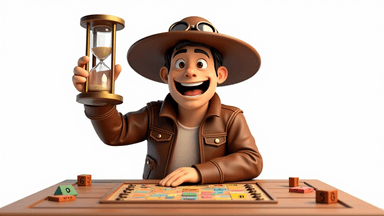
Every Scrabble player has been there: it's game night, the board is halfway full, and one player is agonising over their rack for the fifth minute in a row while everyone else checks their phones. Scrabble without a timer can drag a 45-minute game past the 90-minute mark, and nothing kills game night energy faster than waiting.
The solution is simple — add a timer. Whether you play by official tournament rules with a chess clock or set a casual per-turn countdown, a Scrabble timer transforms the pace, strategy, and fun of the game. Here's exactly how to set one up, what rules to use, and why timed Scrabble is better Scrabble.
Official Tournament Timer Rules
If you've ever watched competitive Scrabble — yes, it's a real competitive scene with national and international championships — you'll notice every game has a chess clock sitting next to the board. Tournament timing is standardised across the two major governing bodies: NASPA (North American Scrabble Players Association) and WESPA (World English-Language Scrabble Players Association).
The Standard: 25 Minutes Per Side
Each player gets 25 minutes of total thinking time for the entire game. A chess clock sits between the players, and the rules work like this:
Your clock runs while you think. When it's your turn, your side of the clock is ticking down from 25 minutes. You can take as long as you want on any single turn — but every second spent is deducted from your total bank.
You hit the clock after your play. Once you place your tiles and announce your word, you press the clock. This pauses your time and starts your opponent's. From that point, it's their time running.
Overtime penalties. If your clock hits zero, you're in overtime. The penalty is 10 points deducted for each minute (or partial minute) over the limit. Going 10 or more minutes over your 25-minute allocation is an automatic forfeit — you lose the game regardless of score.
Why Total-Time Clocks, Not Per-Turn Limits
Tournament Scrabble uses a total-time bank rather than a per-turn countdown because the game's strategic demands vary wildly from turn to turn. Some moves are obvious and take 10 seconds. Others — especially endgame plays where you're calculating multiple possible outcomes — legitimately need several minutes of thought.
A per-turn limit of 2 minutes would punish players on complex turns while being wastefully generous on simple ones. The total-time bank lets players allocate their thinking time where it matters most, which is a strategic skill in itself.
Time management is considered a core skill in competitive Scrabble. Top players deliberately speed through early turns (when the board is open and options are obvious) to bank time for the endgame when every point matters and the optimal play requires more calculation.
Chess-clock Timer
Free online timer — no signup required
How to Set Up a Scrabble Chess Clock
You don't need a physical chess clock to time Scrabble. A free online chess clock works perfectly and is actually more convenient because you can customise the time for different settings.
Tournament Setup (25 Minutes Per Side)
Open your chess clock timer and set each side to 25:00. Place the device (phone, tablet, or laptop) next to the board where both players can easily reach it.
Starting the game: After the first player places their opening word and announces it, they tap the clock. This starts their opponent's time. From this point on, every turn follows this pattern.
During the game: The clock tap happens after you've placed all your tiles, announced your word, and noted the score. You don't tap the clock before your opponent has finished recording the score from your play.
Drawing tiles: In casual timed play, it's fine to draw your new tiles while your opponent's clock is running (after your tap). In strict tournament play, some players draw before tapping — the key is consistency within your group.
Casual Setup (Shorter Timers)
Not everyone wants the intensity of 25-minute tournament timing for a Wednesday night game. For casual Scrabble, shorter total times work well and keep the energy up.
15 minutes per side — A brisk game that rewards quick word recognition over deep strategic calculation. Good for experienced players who want to fit in multiple games per evening.
20 minutes per side — A comfortable middle ground that allows real thinking without the pressure of tournament pace. This is probably the best default for game night groups that want timed Scrabble without it feeling competitive.
10 minutes per side — Speed Scrabble. Chaotic, fun, and surprisingly skill-testing. Words come out fast, mistakes happen, and nobody has time to agonise. Great for two quick games instead of one long one.
Per-Turn Timer: The House Rule Alternative
Some Scrabble groups prefer a simpler approach: a fixed time limit per turn rather than a total-time chess clock. This is easier to manage, doesn't require a chess clock, and works well for groups with mixed experience levels.
How Per-Turn Timing Works
Set a countdown timer for your chosen turn limit. When it's your turn, someone starts the timer. You must place your tiles and announce your word before the timer reaches zero. If the timer goes off mid-turn, your turn is forfeit — you score nothing and play passes to the next player.
Recommended Per-Turn Limits
2 minutes per turn — The most popular house rule. Gives enough time to scan your rack, find a word, and place it strategically, but not enough to over-optimise every possible position. Games run about 45-60 minutes.
1 minute per turn — For fast-paced, high-energy Scrabble. You play what you see immediately — no time for anagram solvers or counting potential scores across three positions. This makes the game more about vocabulary instinct than strategic optimisation.
3 minutes per turn — More relaxed. Suitable for players who are still building their vocabulary or groups where the main goal is social rather than competitive. Games may still run 60-75 minutes with this setting.
If you use a per-turn timer, consider allowing one "extension" per game — a single turn where a player can take an extra minute without penalty. This prevents frustration on the one genuinely tricky turn that every game seems to produce.
Countdown Timer
Free online timer — no signup required
Why Timed Scrabble Is Better Scrabble
Adding a timer to Scrabble isn't just about speed — it fundamentally changes the game for the better in several ways.
It eliminates the pace mismatch problem
Every Scrabble group has a mix of speeds. One player sees their word in 15 seconds, another needs 4 minutes. Without a timer, the fast players spend more time waiting than playing, and the slow player feels rushed by their friends' body language. A timer makes the pace expectation explicit and equal for everyone.
It improves your vocabulary
Counterintuitively, time pressure makes you a better Scrabble player. When you can't spend 5 minutes rearranging tiles, you're forced to develop faster pattern recognition — seeing words in your rack quickly rather than methodically testing every combination. This skill transfers to untimed games too.
It adds a strategic layer
With a total-time clock, deciding how long to spend on a turn becomes a strategic choice. Do you invest 3 minutes searching for a bingo (a 7-letter word using all your tiles for a 50-point bonus), or play a solid 30-point word in 30 seconds and bank that time for later? This time-management dimension adds depth that doesn't exist in untimed Scrabble.
It keeps game night on schedule
A timed Scrabble game with 20 minutes per side will finish within an hour. That means you can play two games in the time that one untimed game might take, or leave time for other games after Scrabble. For game night hosts managing a schedule, timers are essential.
Timer Etiquette for Scrabble
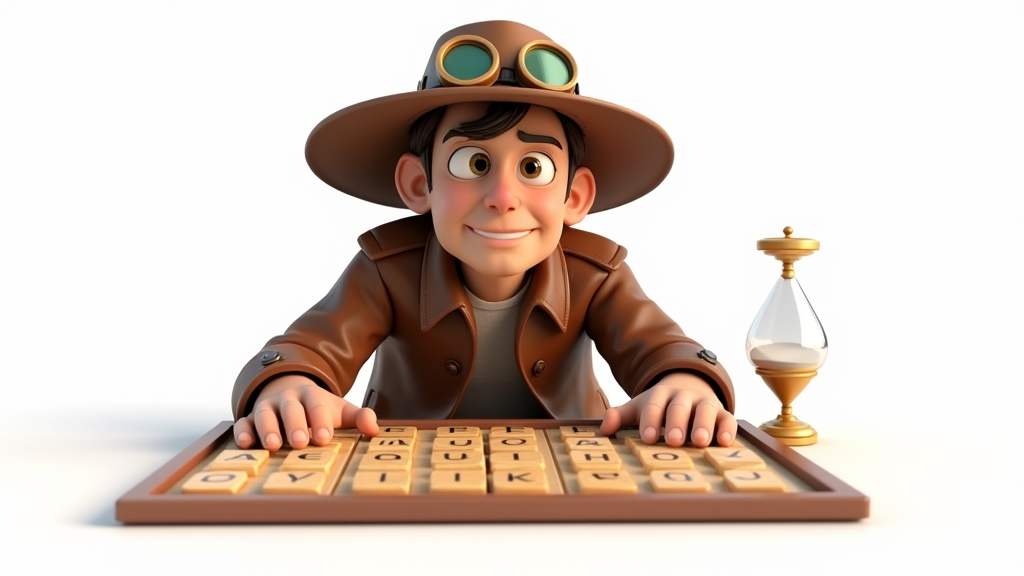
A few unwritten rules help keep timed Scrabble fun and fair.
Don't slam the clock. Tap it firmly but don't hammer it — especially if you're using someone's phone or tablet as a timer. The chess clock tap should feel crisp, not aggressive.
Pause for disputes. If someone challenges a word, pause both sides of the clock (most chess clock apps have a pause function) while you look it up. The challenge resolution shouldn't eat either player's time bank.
Announce before tapping. Always announce your word clearly before hitting the clock. Your opponent needs to hear the word to verify and score it. Tapping first and mumbling second is poor form.
Be consistent with tile drawing. Decide at the start whether players draw new tiles before or after tapping the clock, and stick with it for the whole game. Inconsistency here causes arguments.
New players get extra time. If someone is learning Scrabble or playing their first timed game, give them an extra 5-10 minutes on the clock, or use per-turn timing at 3 minutes instead of throwing them into tournament pace. The goal is to make it fun, not stressful.
Beyond Two Players: Timed Multiplayer Scrabble
Standard Scrabble supports up to 4 players, and timing multiplayer games requires a slight adjustment since most chess clocks are built for 2 players.
Per-Turn Timer (Easiest for 3-4 Players)
The simplest approach for multiplayer Scrabble is a per-turn countdown. Set a countdown timer for 90 seconds to 2 minutes. Start it fresh for each player's turn. This keeps things moving without needing a multi-player chess clock.
Total-Time With Reduced Banks
If you want the strategic depth of total-time clocks with 3-4 players, reduce each player's time bank to keep the total game length reasonable.
3 players: 18-20 minutes per person.
4 players: 15 minutes per person.
These reductions account for the fact that you have more waiting time between turns in multiplayer games, and fewer total turns per player. A 4-player game at 15 minutes per side will finish in about 60-75 minutes — longer than a 2-player game but still contained.
Chess-clock Timer
Free online timer — no signup required
Quick Reference: Scrabble Timer Settings
Here's a summary you can pull up at the start of your next game.
Tournament (2 players): 25 minutes per side on a chess clock. 10 points per minute overtime penalty. Forfeit at 10 minutes over.
Casual timed (2 players): 15-20 minutes per side on a chess clock. No penalties — game ends when a player runs out of time.
Per-turn casual: 1-3 minutes per turn on a simple countdown timer. Turn forfeited if time expires.
Speed Scrabble: 10 minutes per side or 1 minute per turn. Fast, chaotic, and great for repeat games.
Multiplayer (3-4 players): Per-turn countdown at 90-120 seconds, or 15-20 minutes per person on individual time banks.
Set up your free chess clock, put it next to the board, and discover how much better Scrabble plays when everyone's on the clock. Game night will thank you.