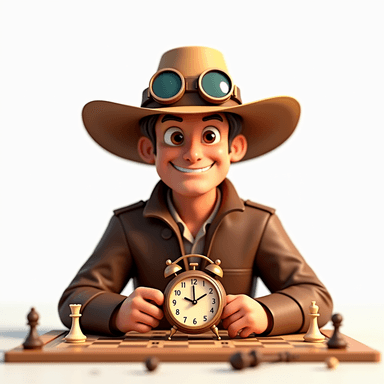
If your game nights are dragging on past midnight, a chess clock — or more precisely, a game clock used the chess-clock way — might be the one fix you haven't tried. Popularised in competitive chess, the chess clock format gives each player a personal pool of time to spend across all their turns. Run out, and you're under pressure. Move fast, and you bank time for the complex decisions later. Applied to a game like Scrabble or Catan, it transforms a two-hour slog into a tight, electric contest.
The good news: you don't need an actual chess clock. GoTimer's free chess clock works in any browser and handles the whole job — no app, no purchase required.
If you're just exploring board game timing for the first time, our guide to best timer settings for every popular board game is a solid starting point — it covers recommended limits by game type across dozens of titles.
What Is a Chess Clock (and Why Does It Work for Any Game)?
A chess clock isn't really a clock — it's a shared time management system. Two timers run in series: when Player A is thinking, their clock counts down. The moment they make their move, they tap a button to stop their clock and start Player B's. Neither player's clock runs during the other's turn.
This creates a beautifully fair dynamic. A fast, decisive player doesn't suffer because their opponent takes forever. An indecisive player can't stall the game indefinitely — their time bank drains. The total game length is predictable: if both players have 10 minutes each, the game can't exceed 20 minutes of turn time (plus any real-time elements like trading or negotiation).
Chess-clock Timer
Free online timer — no signup required
The Turn Timer Alternative: Simpler for Groups of 3+
Chess clocks are ideal for two-player games. For multiplayer games (three or more players), the simpler approach is a per-turn countdown: every player gets the same fixed time for each turn — say, 75 seconds — and a shared clock counts down from that number, resetting after each turn.
This format is easier to manage at a crowded table. You don't need to track individual time banks; the timer just runs, and when it hits zero, the active player commits to their move or forfeits. GoTimer's round timer and countdown timer both work well for this format.
6 Non-Chess Games That Love a Chess Clock
1. Scrabble
Scrabble is practically begging for a chess clock. The official tournament format gives each player 25 minutes total, with a 10-point penalty per minute over the limit. Casual groups usually find 10–15 minutes per player is plenty for a full game. The time pressure is wonderful: instead of agonising over whether QUIXOTIC scores more than QUIXOTE, you just play the best word you can see and move on. For complete tournament-style timer rules, see our Scrabble timer rules guide.

2. Catan (Settlers of Catan)
Catan slows down the moment someone starts trading. A chess clock doesn't fix the trading phase (that's real-time negotiation), but it dramatically speeds up individual turns — building, placing roads, deciding where to expand. Give each player 8–12 minutes for a 4-player game. The turns you thought were complex become refreshingly snappy. For settings tailored to different player counts and game stages, see our Catan turn timer guide.
3. Dominion
Dominion is a deck-building game where slow players can derail the whole session by spending four minutes examining their hand of ten cards. A chess clock with 8–10 minutes per player keeps the pacing brisk without feeling unfair. Experienced players will burn through their time banks efficiently; newer players learn to trust their instincts faster.
Chess-clock Timer
Free online timer — no signup required
4. Hive
Hive is a two-player abstract strategy game often called "chess with bugs." It's a natural fit for chess clock rules. Most casual games run well at 5–8 minutes per player. Competitive players often use 3 minutes. The time pressure adds a layer of bluff and instinct that pure strategy alone doesn't produce.
5. 7 Wonders Duel
This two-player card drafting game already plays fast (20–30 minutes), but adding a chess clock with 5 minutes per player adds genuine tension without changing the game's core feel. It also makes the timing of information reveal — when to grab a card your opponent wants — feel more like a real duel.

6. Twilight Imperium (or any mega-game)
Twilight Imperium sessions can last 8–12 hours. If that sounds like too much, a per-player time bank of 45–60 minutes enforces a natural end time. Players who bank their time early can spend it on the critical late-game turns. It transforms an endurance test into a strategic resource management challenge — which is, arguably, what Twilight Imperium is supposed to be.
How to Set Up a Chess Clock for Board Games
Setting up couldn't be simpler:
On GoTimer: Open the chess clock on any phone or tablet. Set the time per player (start generous — 10 minutes is a good default for most games). Place the device between the two players. Tap the screen to switch whose clock is counting.
For groups of 3+: Switch to the countdown timer or round timer. Set a per-turn limit (60–90 seconds for most games). Designate one player to tap the timer each turn, or place the device in the centre of the table where everyone can see it.
Round-timer Timer
Free online timer — no signup required
Setting the Right Time Limits
Here's a starting point for common game types:
| Game Type | Chess Clock (2P) | Turn Timer (3–6P) |
|---|---|---|
| Light party games | 5 min/player | 30–45 sec/turn |
| Word games (Scrabble) | 10–15 min/player | 90 sec/turn |
| Mid-weight strategy | 8–12 min/player | 60–90 sec/turn |
| Heavy strategy | 20–40 min/player | 2–3 min/turn |
| Mega-games | 45–60 min/player | 3–5 min/turn |
Always err on the generous side for your first timed session. You can tighten limits in future games once you have a feel for your group's average pace.
When a Chess Clock Doesn't Work
A chess clock isn't right for every game. Games with heavy real-time or simultaneous elements — like Hanabi, Pandemic (cooperative), or simultaneous-action games — don't fit the alternating-clock model. Games with lots of out-of-turn interaction (like many deckbuilders with reaction cards) can also get messy when a strict clock is involved.
For cooperative games, a chess clock is almost never appropriate — the goal is collective problem-solving, not competitive time management. For those, a simple per-round countdown that limits total group deliberation time works better.
Building Your Game Night Timer Toolkit
A reliable timer setup doesn't require much — but having it organised before the game starts makes everything smoother.
Choose your device: Any phone, tablet, or laptop works. GoTimer runs in any browser without an app download. One shared device on the table is usually better than everyone checking their own phone — it keeps attention on the game.
Placement matters: Centre of the table is ideal for turn timers so everyone can see the countdown. For two-player chess clock games, prop the device between the two players using a phone stand or lean it against a box. The key is that neither player should have to crane their neck to check the time.
Use sound: Enable the alarm sound so the end of each turn is audible. Players who are deep in thought about their next move shouldn't need to keep one eye on the screen — a beep handles it.
Set ground rules first: Before starting, answer three questions: (1) What happens when the timer hits zero? (2) Can a player call a timeout for a bathroom break? (3) What's the rule if the device dies mid-game? Thirty seconds of planning prevents ten minutes of argument later.
Start generous, then tighten: Your first timed session isn't the time to run a tight ship. Set limits about 50% more generous than you think you need — if you expect turns to take 60 seconds, set 90. Once your group gets comfortable with timed play, you can reduce the limits in future sessions.
Scale into challenge modes: Once timed play becomes normal, try GoTimer's public challenges for personal record tracking. Racing your own best time on decision speed creates a meta-game that keeps regular players engaged across multiple sessions.
For a broader look at which board games benefit most from timing, our 7 board games that need a timer roundup covers the essentials.
The Real Win: Ending Analysis Paralysis
The single biggest enemy of board game enjoyment is analysis paralysis — that painful wait while one player calculates every possible outcome before making a move. A chess clock doesn't punish careful thinking; it just ensures that the cost of deep thought falls on the thinker, not on everyone else at the table.
Groups that introduce timers almost universally report the same thing: games feel faster, more exciting, and — surprisingly — more social. When nobody's waiting twenty minutes for someone else's turn, people talk, laugh, and actually enjoy themselves between their own turns.
Chess-clock Timer
Free online timer — no signup required
If you haven't tried timing your game nights, start with one game this weekend. Pick a familiar title, set generous limits, agree on the rules upfront, and see how it feels. Chances are you'll never go back to untimed play.